Another version of AI has arrived.
And, as usual, the Internet has already gone through the full emotional cycle.
First: “This is incredible.”
Then: “This changes everything.”
Then: “Mathematics is over.”
And, apparently, we are now somewhere around:
“Humanity might be over too.”
In between, we have another increasingly familiar ingredient: controversy over who knew what, who used whose ideas, what data may have influenced what and… whether someone crossed a line. At the time of writing this, I don’t know all the details of the latest dispute. Perhaps there will be more information. Perhaps there will be corrections. Perhaps there will be uncomfortable conclusions as well…
That is exactly why I don’t want us to build an AI strategy around today’s headlines. Because somewhere in the middle of all this noise is a person sitting in a company, responsible for deciding whether AI should actually be deployed, where and how. And that person is receiving two completely contradictory messages:
“AI can do almost everything.”
and five minutes later:
“You see AI? Run.”
My recommendation?
Go surfing. Or ride a bike. Go for a run. Have dinner with your family.
Do something that doesn’t involve an AI benchmark for an hour.
Then come back and think about the problem like a businessperson.
Because something important is getting lost in the noise.
AI is getting very, very good.
That’s a fact.
AI is becoming capable of automating more work, analyzing more information, exploring more possibilities and solving increasingly difficult problems.
We are already seeing this in mathematics, software engineering, scientific research and many other fields.
And this is not something we should fear simply because it is powerful.
It is something we should learn to use.
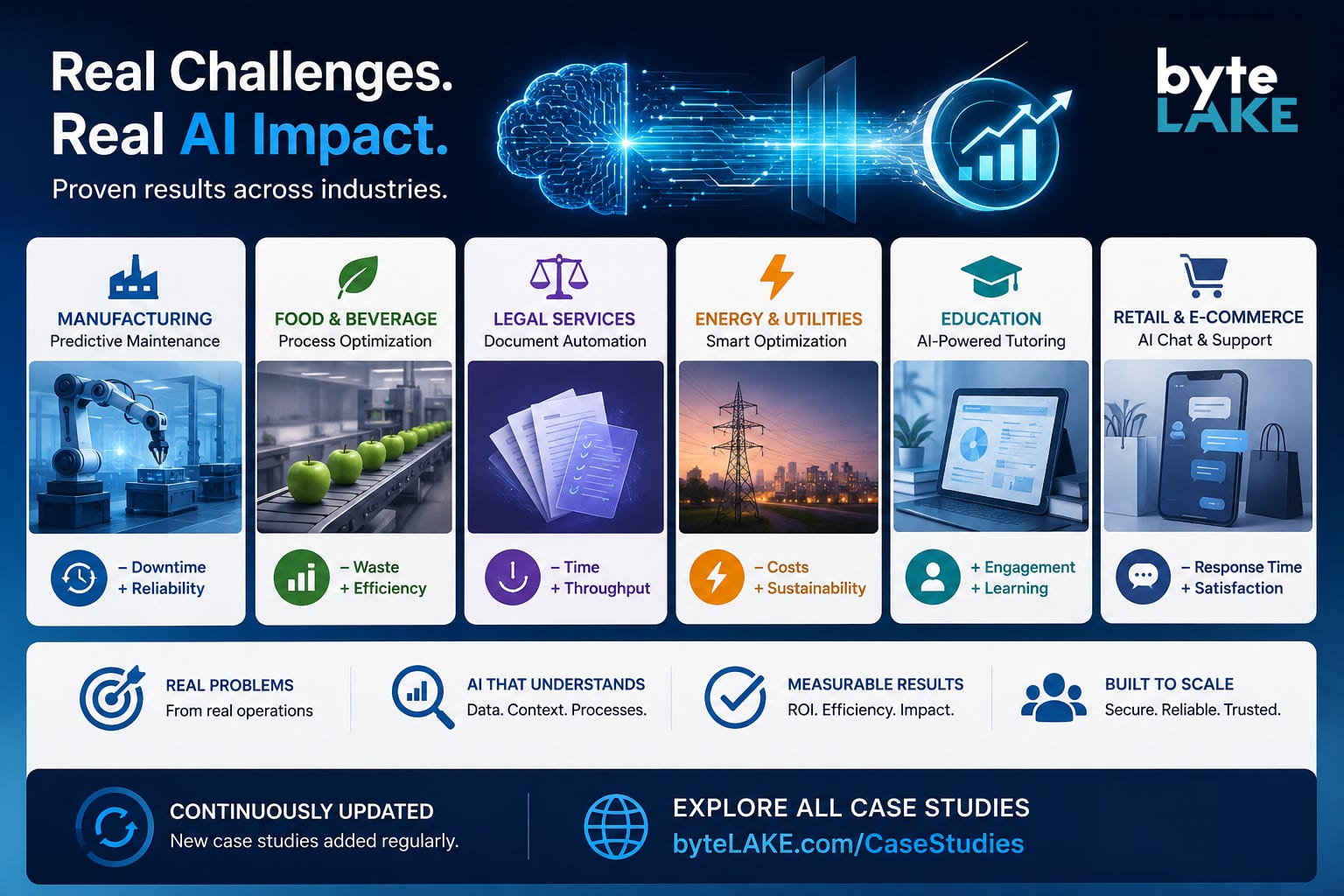
At byteLAKE, for example, we work on much less glamorous—and much more measurable—problems.
We use AI to predict equipment failures and reduce unnecessary maintenance.
We analyze production processes to reduce waste and improve efficiency.
We use computer vision and acoustic analysis for quality control.
We analyze root causes instead of simply detecting that something went wrong.
We optimize energy consumption and complex utility systems.
We build AI Agents that can work with company documents, technical knowledge and operational systems.
And we connect AI with systems such as MES, SCADA, CMMS, ERP and IoT infrastructure.
Soon I’ll also be publishing more case studies covering areas such as AI for jewelry businesses, accounting and back-office operations, additional legal applications and new industrial use cases.
None of this requires believing that AI is magic.
It requires understanding what makes AI useful.
Data Is Not the Only Fuel
Everyone is beginning to understand that AI needs data.
But data is not the only thing that makes an AI system work well.
There is also:
human creativity,
domain expertise,
company know-how,
experience,
business context,
process knowledge,
and the ability to understand what the data actually means.
This is one of the reasons why two companies can use seemingly similar AI technologies and get completely different results.
The model is only part of the system.
Take Feature Engineering.
Raw data doesn’t automatically contain the information an AI model needs in the most useful form. Domain knowledge can be used to transform raw measurements into meaningful signals—health indicators, degradation rates, operating regimes, relationships between variables and other features that help a model understand the underlying process.
In industrial AI, this can mean the difference between detecting something interesting and actually detecting something useful.
Then there is Explainable AI.
A prediction is not necessarily a decision.
If an AI system tells a maintenance engineer that a machine is likely to fail, the engineer needs to understand why.
Which signals changed?
What caused the prediction?
Which factors matter most?
What should we investigate?
Explainability turns an output into evidence.
And then there is Root Cause Analytics.
Detecting that something is wrong is often the easy part.
The real question is:
Why?
That distinction matters enormously in manufacturing, energy, quality control and operational environments. byteLAKE’s current Cognitive Services architecture combines these capabilities with data from systems such as IoT, SCADA, MES, CMMS, ERP and internal documents.
This is why I increasingly think of AI not as a model, but as a system of context, data, expertise, models, infrastructure and people.
And this brings me to a part of AI strategy that is often overlooked.
Where Does Your AI Actually Run?
There is a question that is often treated as an IT implementation detail:
Should we run this AI in the cloud or inside our own infrastructure?
I think it is a strategic decision.
Not because cloud is bad.
And not because Private AI is automatically better.
The right answer depends on the problem.
A cloud architecture can give you excellent scalability, access to powerful infrastructure, fast experimentation and a flexible way to consume advanced models.
Private AI can provide greater control over sensitive data, predictable processing, local inference and independence from external services.
Hybrid architectures can combine both.
The mistake is not choosing cloud.
The mistake is choosing an architecture before understanding the business problem and its economics.
A cheap cloud API can look incredibly attractive at the beginning.
But what happens when the amount of data grows?
What happens when inference becomes continuous rather than occasional?
What happens when you need to process thousands or millions of documents?
What happens when AI becomes part of a production process running 24/7?
What happens when sensitive operational data cannot leave the facility?
What happens when connectivity becomes a bottleneck?
And what happens when the AI becomes so important to the business that switching providers becomes extremely expensive?
On the other side, Private AI is not free magic either.
You need hardware.
You need deployment and maintenance.
You need capacity planning.
You need model optimization.
You need people who understand the infrastructure.
You need to think about scalability.
Sometimes buying and operating your own infrastructure is exactly the right decision.
Sometimes it isn’t.
This is why at byteLAKE we treat Private AI, Hybrid AI and Cloud as architectural choices, not religious beliefs. The architecture should follow the requirements of the business, security, performance, compliance, data and economics.
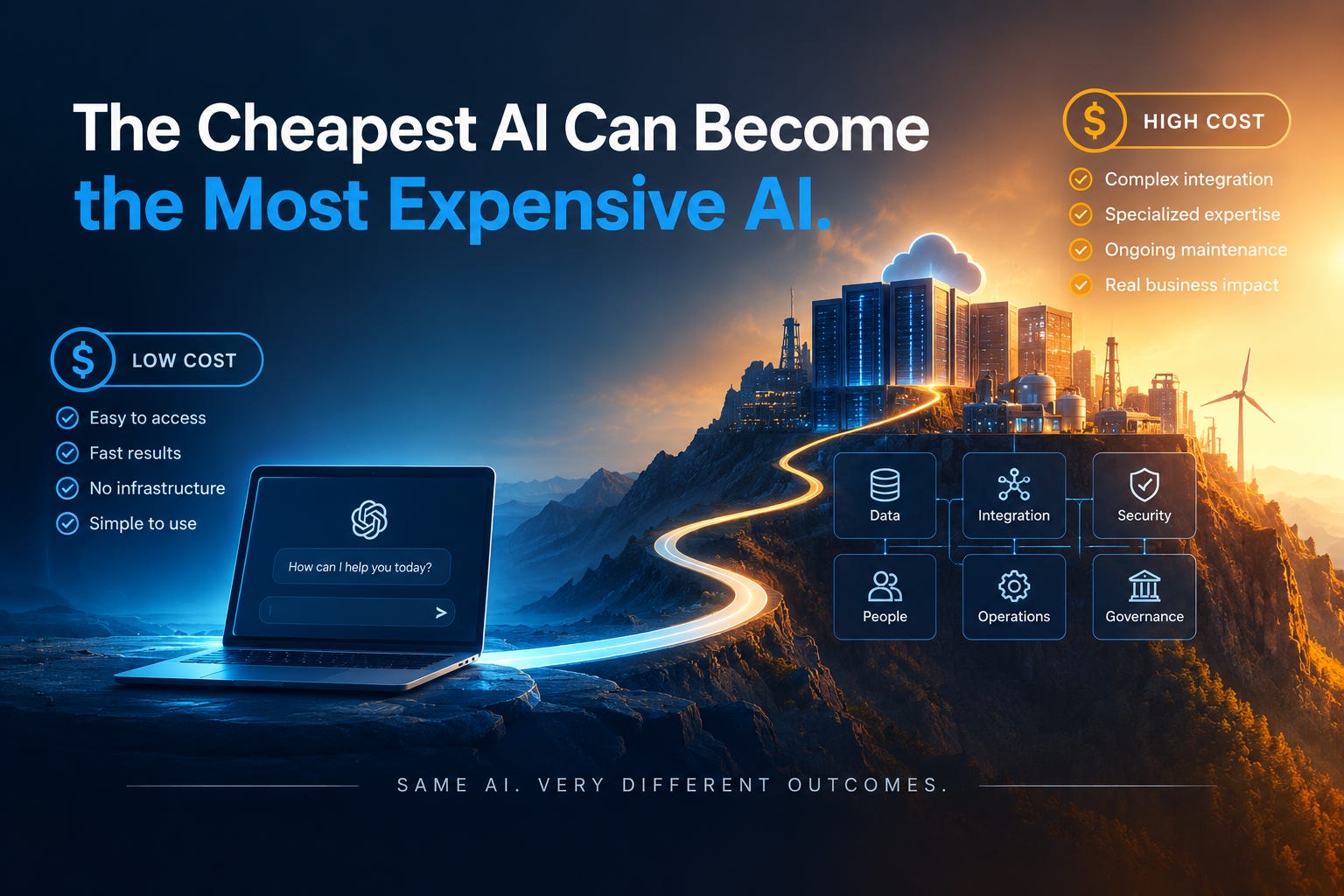
The Cheapest AI Can Become the Most Expensive AI
This is one of the things I wish more companies considered.
When someone tells me: “We can just buy a license and someone will implement it for us.”
my next question is: For what?
What problem are we solving?
What does that problem cost today?
How frequently does it occur?
What data is available?
Who understands the process?
Where does the AI need to run?
What happens if the system is wrong?
What happens when usage grows?
What is the expected business value?
And perhaps the most important question:
Will this still make economic sense two or three years from now?
Because AI should not exist merely because AI is available.
It should pay for itself.
That doesn’t necessarily mean direct revenue.
For a nonprofit organization, the business objective might be to process documents faster, reduce administrative work or make services easier for people to access.
For a manufacturer, it might be:
reduce unplanned downtime,
reduce production waste,
improve quality,
optimize maintenance,
improve production planning,
reduce energy consumption,
prioritize alarms,
or identify the root causes of recurring problems.
For a customer-support organization:
reduce response time,
automate repetitive requests,
give agents better access to company knowledge,
or provide consistent answers based on internal documentation.
For accounting and back-office operations:
automate document processing,
extract and validate information,
reconcile data,
classify transactions,
and reduce repetitive manual work.
For legal teams:
search and analyze large document collections,
identify relevant clauses,
compare documents,
prepare summaries,
and assist professionals with research.
These are not theoretical AI problems.
They are business problems.
And that distinction is critical.
Don’t Start With “Which AI Should We Buy?”
Start with:
Why do we need AI?
Then:
Do we actually need AI?
Then:
What business problem are we trying to solve?
Then:
What is that problem worth?
Only after answering those questions should we start discussing models, agents, GPUs, cloud providers, databases or anything else.
This is also why our deployment process at byteLAKE starts with identifying the expensive problem, mapping the available evidence, building the AI context, deploying into the existing workflow and measuring the result.
The technology comes after the problem.
Not before it.
Human + AI Is the Interesting Part
There is another thing I keep coming back to.
The current conversation often asks:
“What will AI replace?”
I think this is a remarkably limiting question.
A much more interesting one is:
“What can humans and AI do together that neither could do alone?”
AI can process enormous amounts of information.
Humans understand context.
AI can explore thousands of possibilities.
Humans decide which questions are worth asking.
AI can identify patterns.
Humans understand consequences.
AI can automate.
Humans define what should and should not be automated.
And perhaps most importantly:
AI can make experimentation dramatically cheaper.
That changes the economics of exploration.
It means we can test ideas we previously couldn’t afford to test.
Build things that previously weren’t economical to build.
Explore problems that previously weren’t worth exploring.
And perhaps discover opportunities that simply weren’t visible when experimentation was expensive.
That’s the part of AI that I find most exciting.
Not the latest benchmark.
Not whether someone has declared AGI.
Not whether the Internet thinks mathematics has ended this week.
And certainly not whether humanity has another ten years left.
So What Should You Do?
If you are a CEO, CTO, CIO, business owner or department leader thinking about AI, I would suggest something very simple.
Ignore the noise for a moment.
Don’t start with the latest model.
Don’t start with the latest AI agent.
Don’t start with a license.
Don’t start with a chatbot.
Start with your business.
Where are you losing money?
Where are you losing time?
Where are people doing repetitive work?
Where are decisions being made with insufficient information?
Where are experts spending their time on tasks that could be automated?
Where does valuable company knowledge disappear into spreadsheets, documents, emails and people’s heads?
And where could better information produce a measurable improvement?
Then ask what role AI should play.
Maybe the answer is a cloud service.
Maybe it is Private AI.
Maybe it is a hybrid architecture.
Maybe it is a traditional analytical model.
Maybe it is an AI Agent.
And maybe the answer is no AI at all.
That’s perfectly fine.
The objective isn’t to deploy AI.
The objective is to create value.
AI is simply one of the most powerful tools we have ever been given to do that.
So yes, another version of AI has arrived (recently).
The Internet will celebrate it.
Then fear it.
Then declare something dead.
Then declare something else immortal.
And then move on to the next model.
Meanwhile, businesses still need to reduce waste, maintain machines, process documents, answer customers, manage energy, improve quality and make better decisions.
That’s where I would put my energy.
Less hype. Less panic.
More questions. More experimentation. More building.
And above all:
Better problems. Better AI. Better decisions.
If you’re considering AI for a department, a specific business process or your entire organization, I’d be happy to talk through the problem before talking about the technology. That’s usually where the most valuable conversation starts.